Achieving Uncompromising System Availability and Site Reliability Engineering with SRESchool.com
Introduction
Contemporary software engineering requires relentless uptime, minimal response latency, and seamless scalability. When complex digital services crash, user trust evaporates in seconds. Building resilient applications demands far more than functional code; it requires rigorous production engineering. This comprehensive guide explores how forward-thinking engineering teams overcome availability challenges through structured principles, practical methodologies, and specialized educational frameworks.
Understanding Site Reliability Engineering and Why It Matters
Site reliability engineering bridges the critical gap between software development and traditional IT operations. Instead of depending on manual server babysitting, practitioners apply software engineering solutions to operational roadblocks. This discipline keeps large-scale systems stable under punishing user traffic. Without these structured practices, organizations constantly suffer from recurring outages and fragmented monitoring stacks.
What Professionals Can Learn Through SRE Training
Structured SRE Training empowers engineers to transition from reactive firefighting to proactive architecture design. Learners conquer core concepts like service level objectives, monitoring pipelines, and incident response frameworks. These programs teach practitioners how systems recover gracefully from unexpected failures. Mastering these competencies gives engineers the confidence to manage complex distributed environments.
Understanding SRE Certification and Professional Skill Development
A formal SRE Certification provides a structured framework for professionals to validate their technical expertise. Certification requirements, assessment methods, and eligibility criteria vary by certification provider. While credentials never guarantee employment or raises, they demonstrate serious dedication to professional growth. Studying for these milestones encourages engineers to explore production engineering theory and practice deeply.
Choosing a Site Reliability Engineering Course
Selecting the right Site Reliability Engineering Course demands a close look at curriculum depth and practical application. A thorough course covers everything from basic system monitoring to advanced automated incident recovery. Learners must evaluate whether a specific program matches their current skill level and daily operational duties. Hands-on labs and realistic production scenarios make learning far more impactful than passive reading.
What It Means to Become a Certified Site Reliability Engineer
Becoming a Certified Site Reliability Engineer proves a solid grasp of reliability measurement, incident management, and automation. Certified individuals master the balance between feature velocity and system stability. This expertise helps teams intercept outages before end users notice degradation. However, professional impact relies just as heavily on hands-on experience as it does on formal badges.
Exploring SRE Consulting for Organizations
External SRE Consulting helps businesses audit their reliability maturity and uncover hidden operational risks. Consultants collaborate with internal engineering teams to evaluate monitoring gaps, incident workflows, and architectural bottlenecks. This outside perspective frequently highlights inefficiencies that internal teams miss amid daily firefighting. Companies utilize these insights to streamline deployment pipelines and fortify infrastructure resilience.
Understanding SRE as a Service
The model of SRE as a Service lets businesses access specialized reliability expertise without building massive internal teams from scratch. This approach benefits growing companies scaling their cloud infrastructure rapidly. External reliability partners configure observability platforms, establish alerting thresholds, and guide incident postmortems. Implementation depends entirely on an organization's specific technical architecture and team size.
Why Corporate SRE Training Can Help Engineering Teams
Implementing Corporate SRE Training aligns an entire engineering organization around unified reliability goals. When DevOps, platform, and software development teams share a common vocabulary, cross-functional collaboration thrives. Companies leverage customized corporate training to target specific technology stacks and internal workflows. This shared mindset slashes friction during production rollouts and major incident responses.
Learning Through Practical SRE Tutorials
An effective SRE Tutorial breaks intimidating reliability concepts into manageable, actionable steps. Tutorials allow engineers to test configuration files, monitoring queries, and automation scripts safely. Instead of remaining purely theoretical, strong instructional resources guide learners through real-world deployment and debugging scenarios. These guides serve as quick references when engineers face unfamiliar production puzzles.
Exploring SRE Tools for Modern Reliability Engineering
Choosing the right SRE Tools depends heavily on an organization's architecture, team skills, scale, and budget. No single tool fits every environment or use case. Tool categories typically encompass:
- Monitoring and metrics collection platforms
- Centralized logging and log analysis systems
- Distributed tracing for microservices architectures
- Incident management and alerting applications
- Infrastructure automation and provisioning utilities
- Cloud management and capacity planning software
Understanding SLOs, SLIs, and Error Budgets
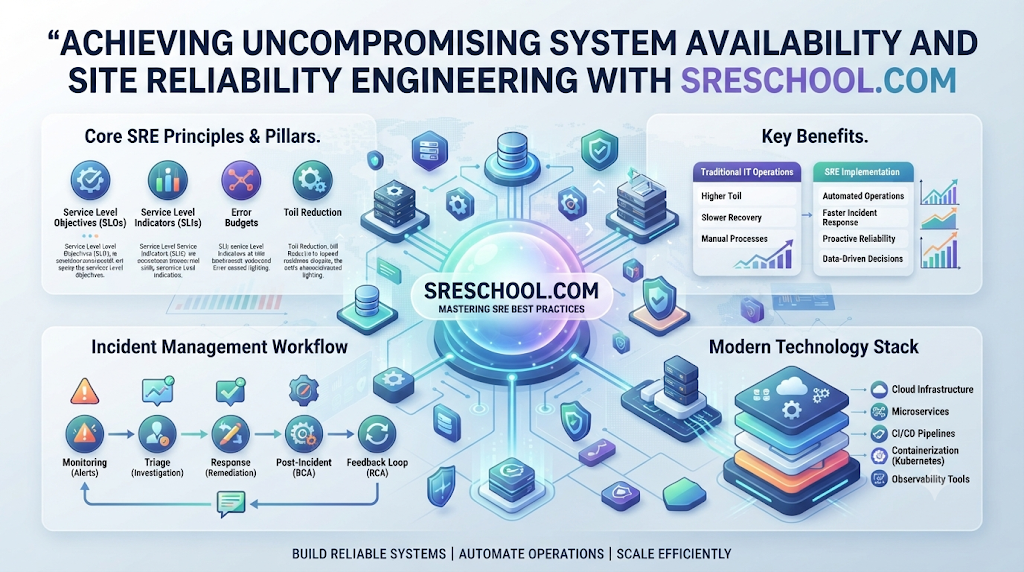
Service level indicators measure quantitative system performance aspects, such as request latency or error rates. Service level objectives define the target reliability level for those indicators over a specified timeframe. Error budgets tie engineering velocity directly to reliability by measuring how much downtime a service tolerates. Balancing this budget helps teams decide when to pause feature releases and fix stability bugs.
How Observability Supports Site Reliability Engineering
Observability expands beyond traditional monitoring by helping engineers understand internal system states through external outputs. Metrics capture numerical trends, logs record discrete events, and traces follow requests across distributed microservices. Combined, these signals help teams diagnose unfamiliar failures rapidly. Without strong observability, troubleshooting complex production systems resembles searching for a needle in a haystack.
Understanding Incident Management and Postmortems
Effective incident management demands clear detection, rapid triage, structured communication, and calm mitigation. When outages strike, teams rely on defined roles to restore service quickly. Once stability returns, blameless postmortems uncover root causes. Documenting these lessons prevents identical issues from plaguing the system later.
Incident Phase
Core Objective
Typical Team Action
Detection
Spot anomalies early
Monitor automated alert triggers
Triage
Assess severity and impact
Assign roles and open communication channels
Mitigation
Restore service quickly
Roll back changes or route traffic
Postmortem
Learn from failure
Conduct blameless reviews and build action items
How Automation and Toil Reduction Improve Reliability
Toil represents repetitive manual operational work offering zero enduring value while scaling linearly with system growth. Automation eradicates toil by replacing manual interventions with scripts, CI/CD pipelines, and self-healing mechanisms. However, poorly written automation introduces fresh risks if developers fail to test it rigorously. Teams must monitor automated workflows just as closely as production applications.
Understanding Capacity Planning and Cloud Reliability
Capacity planning ensures cloud infrastructure handles sudden traffic surges without performance degradation. SRE teams analyze historical resource utilization, traffic trends, and hardware limits to forecast future requirements. Cloud reliability also demands architectures that survive regional outages gracefully. Cost-awareness drives this process, balancing high availability against reasonable cloud expenditure.
Building a Practical SRE Implementation Approach
Implementing site reliability engineering requires a gradual, deliberate strategy rather than an overnight overhaul. Organizations typically start by defining basic SLIs and SLOs for critical customer-facing services. Next, they refine incident response workflows and squash manual toil through targeted automation. Reliability maturity matures organically as teams leverage production data and adapt practices to their technology stack.
How SRESchool.com Supports SRE Learning and Professional Development
Platforms like SRESchool.com consolidate valuable learning materials, training pathways, and professional guidance for modern engineers. Whether individuals seek an introductory tutorial, structured training, or comprehensive insights on tool categories, a centralized resource simplifies the learning journey. Organizations also tap into corporate training, consulting, and service offerings to strengthen their internal reliability posture.
Why Reliable SRE Knowledge Is Becoming More Important
As software ecosystems grow increasingly distributed and intricate, manual oversight falls short. Businesses depend on continuous uptime to safeguard customer satisfaction and revenue streams. Engineers wielding strong reliability principles navigate unexpected production failures with total confidence. Investing in reliability education guarantees that engineering teams remain resilient amidst a fast-moving technology landscape.
Frequently Asked Questions About SRESchool.com
What primary purpose defines the mission of SRESchool.com? SRESchool.com functions as an advanced educational portal and professional advisory center designed to equip engineers with world-class production reliability capabilities.
Which technology professionals extract maximum value from the site? Software developers, infrastructure architects, cloud specialists, DevOps practitioners, and operations leaders maintaining high-scale architectures benefit immensely.
Do learners earn official certification titles directly? Credential guidelines and testing criteria vary across global certifying bodies, though structured study tracks prepare participants thoroughly for official evaluations.
What core technical domains anchor the curriculum? Syllabuses generally emphasize service level indicators, performance objectives, error budgeting math, observability telemetry, incident routing, and automated remediation.
How do professional consulting services drive enterprise value? Specialists audit operational maturity, streamline troubleshooting loops, expand telemetry visibility, and dismantle repetitive manual toil across engineering units.
What features define the dedicated external support model? Third-party reliability practitioners deliver specialized infrastructure management and scalability oversight tailored explicitly to unique enterprise demands.
Can commercial enterprises arrange private team instruction? Organizations utilize tailored training blueprints to synchronize entire technology divisions around standardized, scalable reliability frameworks.
Which technology segments populate the tutorial collection? Guides examine metric monitoring tools, log aggregators, distributed tracing frameworks, incident dispatchers, infrastructure automation utilities, and capacity planning software.
Are these instructional guides welcoming to industry beginners? Learning materials adapt seamlessly for novices embarking on their reliability journey and seasoned engineers refining advanced operational methodologies.
How does the site foster tangible, real-world competence? The platform merges practical tutorials, structured courses, and advisory solutions focused squarely on everyday production hurdles and operational scenarios.
Final Thoughts
Achieving enduring system stability requires blending technical depth, architectural insight, and cross-functional teamwork. Prioritizing clear performance metrics, comprehensive observability, and disciplined automation allows engineering teams to build resilient architectures that endure heavy scaling challenges. Platforms like SRESchool.com provide vital guidance for professionals seeking career growth and long-term production resilience.