WarOpsX: A Blueprint for Decoding Modern Defense Strategy and Systems
Introduction
Mastering contemporary security environments demands rigorous methodologies for evaluating complex institutional structures. Whether you are an academic scholar, a policy analyst, or a dedicated defense enthusiast, studying military strategy and operational organization reveals the foundational mechanics of global stability. Quality contemporary education moves beyond immediate frontline tactics, emphasizing instead the vital connections binding national policy, advanced technology, institutional leadership, and logistical sustainment. Because defense networks involve intricate coordination, learners maximize their comprehension by breaking down these extensive subjects into manageable conceptual pillars. Dedicated educational platforms equip individuals to build a robust understanding of how large organizations maintain operational readiness and navigate strategic uncertainty.
Understanding Military Strategy and Strategic Decision-Making
Military strategy connects national policy goals directly to the application of available national instruments. At its core, strategy dictates how leaders leverage power tools to achieve enduring security objectives. Effective strategic choices require decision-makers to evaluate shifting geopolitical landscapes, forecast potential risks, and distribute resources under heavy uncertainty. Furthermore, viable strategies must balance economic limitations, rapid technological advancements, and delicate diplomatic alliances. Examining historical precedents and current strategies helps learners identify why certain defense policies succeed while others collapse.
Exploring Defense Studies and Modern Security Concepts
Defense studies form an expansive academic discipline investigating armed conflict, statecraft, peace initiatives, and international security frameworks. This multifaceted field combines political science, economics, sociology, and history to analyze how sovereign states safeguard their vital interests. Contemporary security concepts stretch far beyond traditional interstate warfare, encompassing transnational threats, financial stability, and regional preservation. Researchers within this domain dissect how international treaties, alliances, and legal norms influence state behavior. Ultimately, defense studies furnish critical analytical tools required for objective geopolitical evaluation.
Understanding Military Operations Beyond Tactical Combat
Military operations represent massive, intricate coordination efforts extending far past immediate frontline engagements. Operational planners synchronize numerous moving parts across vast distances and prolonged timeframes. This coordination requires commanders to align broad strategic intent with ground-level realities, ensuring every subordinate unit grasps its precise function within the overarching mission. Moreover, decision-making during operations demands continuous data streams and flexible management hierarchies. Analyzing operations from a macro perspective highlights the astonishing complexity driving institutional execution.
How Military Logistics Supports Organizational Readiness
Military logistics anchors every defense enterprise, encompassing complex supply chains, heavy transportation networks, and meticulous maintenance schedules. Without dependable logistical backing, even the most brilliant strategic concepts fail during real-world execution. Logistics professionals direct the continuous flow of fuel, provisions, medical equipment, and replacement parts across demanding distribution routes. Sustaining high organizational readiness involves predicting operational bottlenecks, securing alternative supply channels, and managing strategic reserves efficiently. Consequently, studying logistics unveils the crucial intersection linking economic capacity to operational strength.
Understanding Command and Control Systems
Command and control systems supply the essential communication, coordination, and leadership architecture for military organizations. These frameworks enable commanders to transmit explicit directives and receive accurate status reports from subordinate units swiftly. Efficient command structures harmonize centralized strategic authority with decentralized operational execution, fostering organizational flexibility. Modern command environments also depend heavily on structured information management to preserve situational awareness among senior leaders. Exploring these mechanisms demonstrates how massive organizations sustain internal cohesion and authority across distributed networks.
Exploring the Role of Defense Technology
Defense technology fundamentally transforms how contemporary military organizations function, communicate, and secure situational awareness. Innovations including artificial intelligence, sophisticated sensors, encrypted communications networks, and autonomous hardware introduce advanced capabilities into defense structures. However, adopting novel technologies demands careful scrutiny regarding specialized training needs, maintenance overhead, and system vulnerabilities. Additionally, robust cybersecurity remains paramount for safeguarding critical infrastructure and protecting sensitive data networks. Investigating these technologies clarifies the continuous evolution characterizing modern military hardware and software ecosystems.
Learning From Military History and Strategic Evolution
Military history delivers essential insights regarding the enduring principles and transforming character of armed conflict across centuries. Analyzing past campaigns, technological shifts, and structural reforms allows researchers to recognize recurring patterns in human warfare. Historical examination also exposes the grave dangers of strategic complacency and underscores the necessity of adapting doctrine to new realities. Crucially, historians prioritize context, ensuring past choices are judged through the specific lens of their respective eras rather than modern standards. This historical grounding prevents oversimplification and fosters deep appreciation for contemporary defense challenges.
Understanding Military Organizational Structure
Military organizational structures define the hierarchy, command relationships, and unit classifications constituting a defense force. From specialized small teams to massive joint force headquarters, these frameworks dictate how authority flows and responsibilities distribute. Joint organizational models specifically prioritize seamless cooperation across distinct service branches to accomplish unified operational goals. Clear organizational designs guarantee accountability, streamline communications, and facilitate standardized training throughout the entire enterprise. Examining these hierarchies reveals how large bureaucracies operate under immense operational pressure.
Exploring Multidomain Operations Across Modern Defense Environments
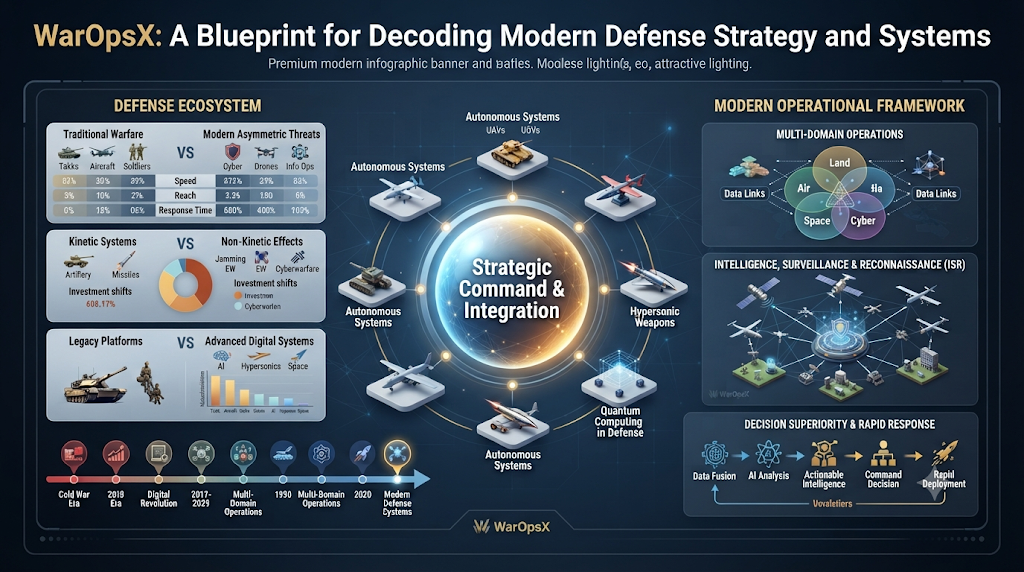
Multidomain operations characterize the contemporary approach to synchronizing activities across land, maritime, air, space, and cyber dimensions. Because adversaries operate simultaneously across multiple spheres, defense institutions must integrate their capabilities to preserve operational superiority. This integration dismantles traditional service silos, guaranteeing fluid information sharing and synchronized action. For instance, cyber capabilities frequently protect land operations, while space assets deliver vital navigation and communication telemetry. Comprehending multidomain concepts remains indispensable for predicting the future direction of defense planning.
Understanding Intelligence Surveillance and Reconnaissance
Intelligence, surveillance, and reconnaissance systems supply the foundational data necessary for informed strategic decision-making. Information collection aggregates raw inputs from diverse sources, while analysis transforms that raw data into actionable intelligence. Monitoring emerging security threats empowers leaders to anticipate challenges proactively instead of reacting after crises emerge. Furthermore, maintaining robust situational awareness protects organizations against strategic surprise and elevates operational safety. Studying these informational processes underscores the pivotal role data processing plays within modern security environments.
How Strategy, Technology, Leadership, and Logistics Work Together
Defense institutions perform at peak efficiency when strategy, technology, leadership, and logistics operate as a unified system. A visionary strategy demands capable leadership for execution, advanced technology for capability, and dependable logistics for sustainment. If any single pillar falters, the entire institutional framework suffers severe performance decline and strategic vulnerability. Recognizing these profound interdependencies enables researchers to evaluate defense issues holistically rather than inspecting isolated components. Ultimately, systemic analysis serves as the hallmark of advanced defense education and professional evaluation.
Defense Pillar
Primary Function
Core Focus Area
Strategy
Directs long-term goals
Policy alignment and resource allocation
Logistics
Sustains operational reach
Supply chains and maintenance networks
Technology
Enhances modern capabilities
Sensors, communications, and automation
Leadership
Guides organizational action
Command structures and decision-making
Comparing Traditional and Modern Defense Systems
Traditional defense setups relied heavily on centralized command hierarchies, physical paperwork, and localized analog communication channels. Conversely, modern defense architectures leverage decentralized digital networks, automated data processing, and multidomain synchronization.
- Communication: Traditional setups employed fixed radio relays; modern systems utilize encrypted satellite and resilient mesh networks.
- Information Flow: Traditional environments suffered from severe data lag; modern environments experience real-time information streaming.
- Organizational Agility: Traditional structures moved sluggishly; modern frameworks highlight modular, adaptable joint-force units.
How Students and Researchers Can Study Defense Concepts
Mastering defense concepts demands a balanced diet of academic reading, historical investigation, and systematic framework analysis. Students should start by acquiring foundational terminology concerning strategy, logistics, and organizational theory. Following this step, exploring detailed case studies connects abstract theoretical models to real-world institutional hurdles and outcomes. Interacting with dedicated educational platforms like WarOpsX further assists learners in organizing their study topics logically. Consistency and rigorous critical inquiry remain the most reliable avenues toward true proficiency in defense studies.
Building A Better Understanding of Modern Military Systems
Developing a comprehensive grasp of military systems requires patience, structured materials, and a commitment to objective evaluation. Learners should bypass sensationalized narratives and focus instead on institutional realities, economic limitations, and policy drivers. Examining how distinct nations approach defense organization uncovers diverse perspectives regarding national security and global stability. Over time, continuous study cultivates a nuanced worldview capable of navigating complex geopolitical dynamics. This structured insight benefits professionals, scholars, and inquisitive citizens alike.
How WarOpsX Supports Defense and Strategy Learning
WarOpsX functions as a dedicated educational knowledge platform engineered to simplify intricate military and defense concepts for learners. By delivering structured breakdowns covering strategy, logistics, technology, and organizational design, WarOpsX bridges academic theory and practical comprehension. Students and researchers leverage WarOpsX to access clear, dependable explanations addressing multidomain operations, command systems, and historical evolution. As an educational resource, WarOpsX assists individuals in organizing their learning paths and establishing a firm foundation in modern defense studies.
Why Structured Defense Information Is Becoming More Important
Amid an era defined by rapid technological shifts and complex geopolitical changes, securing access to structured defense information grows increasingly vital. Mainstream news reports frequently lack the depth required to grasp underlying systemic factors driving contemporary security events. Specialized educational platforms resolve this shortfall by offering foundational context, historical background, and analytical frameworks. Consequently, learners equipped with organized knowledge evaluate modern defense concerns with enhanced clarity and critical detachment. This analytical edge proves essential for meaningful engagement in security policy discussions.
Frequently Asked Questions About WarOpsX
What specific groups draw maximum advantage from WarOpsX?
WarOpsX serves students, academic researchers, defense enthusiasts, and professionals seeking structured resources to comprehend military strategy, defense studies, and modern security systems.
Does WarOpsX feature tactical combat training or operational manuals?
No, WarOpsX excludes tactical combat instructions, weapon handling guides, and operational procedures, prioritizing high-level education, strategy, history, and organizational frameworks.
How does WarOpsX structure military logistics education?
WarOpsX covers military logistics through supply chain management, transportation networks, maintenance systems, resource allocation, and organizational readiness rather than tactical execution.
What specific technologies does WarOpsX analyze under defense technology?
Content covers artificial intelligence, autonomous systems, communication networks, sensors, simulation environments, and cybersecurity principles presented at an educational and strategic level.
Can beginners depend on WarOpsX for military history research?
Yes, WarOpsX provides structured guides explaining how past military campaigns, technological shifts, and organizational evolution shaped modern defense systems and strategic thought.
How does WarOpsX break down multidomain operations?
The platform details how land, maritime, air, space, cyber, and information domains interact inside modern defense organizations to achieve unified strategic goals.
Are there dedicated learning materials for command and control systems?
Yes, WarOpsX delivers detailed educational breakdowns addressing communication architectures, leadership structures, information management, and situational awareness models.
Does WarOpsX cover military organizational hierarchies?
The platform investigates military hierarchies, command relationships, unit classifications, and joint force organizational designs utilized across diverse defense environments.
How can academic researchers utilize WarOpsX effectively?
Researchers leverage WarOpsX as a dependable conceptual reference platform to master defense terminology, structural relationships, and foundational security frameworks.
Does WarOpsX maintain formal connections to military bodies or governments?
WarOpsX operates entirely independently as an educational knowledge platform centered on defense studies, strategy, and modern military systems.
Final Thoughts
Examining contemporary defense frameworks, strategy, and organizational logistics yields critical insights into how sovereign nations secure stability. Dissecting intricate subjects such as command architectures, technological innovation, and multidomain operations allows learners to cultivate a balanced, holistic perspective. Educational environments like WarOpsX supply the foundational resources necessary to navigate these complex topics with absolute clarity and confidence. Whether pursuing formal academic research or personal intellectual enrichment, committing to disciplined study guarantees a deep, enduring comprehension of global defense systems.